I heard recently from the descendant of a Roswell mill worker who would like more information about the Roswell mill during the Civil War and about the Swords family in connection with that.
Lydia Swords is believed to have worked in the Roswell mill. There were four or five sisters together, and there is evidence to suggest they may have been part of the deportation to the North in the summer of 1864.
If anyone has information about these sisters, please respond to my blog, and I will share the information.
Thursday, February 28, 2008


Thursday, January 24, 2008
Great Granddaughter Shares Memories of Synthia Catherine Stewart Boyd

Synthia Catherine Stewart was nine years old when General William Tecumseh Sherman's troops marched into Georgia in 1864. Her father was off fighting with the Campbell Salt Springs Guards for the Confederacy http://walterstewart.org. She and her mother, her uncle, two sisters and a brother were among those who watched as Sherman's troops burned the New Manchester mill on the banks of Sweetwater Creek outside Atlanta http://www.friendsofsweetwatercreek.org. The six family members were then taken by wagon to Marietta where they boarded a train and made the trip north to Louisville, having been charged with treason for supporting the Confederacy. Synthia Catherine's story, and that of other mill workers at New Manchester and also at Roswell, Georgia, is told in the book North Across the River.
Synthia Catherine's great granddaughter Glenda Hilliard, who makes her home in Abilene, Texas, has shared wonderful memories of growing up with a great grandmother who survived that Civil War trip and then made a life for herself and her family in Texas.
Here, in her words, are some of those memories:
- Synthia Catherine and her family moved to Sidney, Texas, in 1903 when their youngest child (Glenda's grandmother) was seven years old They reared nine children of their own and six younger siblings after her husband's parents passed away. She was a wonderful grandmother and the heart of our family. She was loved by many and known as Granny Boyd by all in our small community.
- I will never forget the gatherings at her house where there was always lots of good food, love, laughter and many stories told. Her house was old and unpainted, without electricity, indoor plumbing, or running water, but we all thought it was a mansion because Granny lived there. It had a big front porch that held cane-bottomed chairs and rockers. There was a metal bucket on a small table with water and a dipper to drink from. We all drank from the same dipper and probably shared more than stories.
- Granny lived with her daughter, Rommie, and son-in-law in her latter years. He sold eggs and butter to the little grocery store in our town. They never had much money but were very frugal and always took good care of the things they had and never wasted a thing. Even their outdoor toilet smelled good. They kept ashes from the fireplace in a big bucket in the toilet to cover the "deposits" we made.
- Granny did all their cooking on a wood stove, and everything tasted like it was cooked by a famous chef. She always sent a surprise to me on Saturdays when her son-in-law came to Sidney to bring eggs and butter to the store to sell. It would be a pretty, handmade dress for my doll, pretty rocks or arrowheads, ostrich feathers, tea cakes that she had made on her wood-burning stove or anything she thought I might like. Then I would send her a surprise when he went home. I usually sent her a jar of maraschino cherries--her favorite--or some beautiful piece of artwork I had done.
- Granny had a great love for nature and all the beauty of God's creation. she often called me (on our crank telephone) to go outside to see a pretty cloud formation, an airplane (which was a rare occasion), or a ring around the moon.
- Granny died when I was eleven, and I thought I would surely die, too. She was such an example, and I feel sure I am a better person today because of her influence in my life. Everyone should have a great grandmother like Granny. All of the grandchildren thought that they were her favorite, but I knew that I was.
Synthia Catherine Stewart http://tattlingtales.com/Study-Guides/New-Manchester-Girl-Study-Guide.html lived to be 96 years old. She is buried in the Sidney Pendergrass Cemetery next to her husband.
NORTH ACROSS THE RIVER Question Finally Answered
ADDITIONAL NOTE: Glenda Hilliard wrote on January 24, 2008 to point out that her grandmother, the youngest child of Synthia Catherine Stewart Boyd, is the young woman in the lower left of the photo shown here. She also said, "I love your blog about Granny. She would be amazed that people are still remembering her after all these years...Thanks so much for making Granny's memories come to life."
When I wrote the book North Across the River (Crane Hill 1999), I interviewed many descendants of mill workers from Roswell and Sweetwater Creek, Georgia, but I was never able to connect with the family of Synthia Catherine Stewart Boyd. In the archives of the Atlanta History Museum, I had discovered the transcript of a phonograph recording she made in the 1940s for her grandson Elwood Boyd--way out in Comanche County, Texas. That recording provided details I would not have had about the mill workers who were arrested by General Sherman in 1864, charged with treason, and sent north so they could not continue to make cloth for the Confederacy. Synthia Catherine was about nine years old when she and her mother and uncle, her two sisters and one brother were forced to make the journey to Louisville, Kentucky.
I checked records in Georgia and in Texas but was not looking in the correct places. I tried to reach a branch of the family in Columbia, South Carolina, but found only disconnected telephone numbers. The Internet was up and running at that time, but search engines were not as efficient as they are now. One red herring in my search was the fact that a reporter for an Atlanta newspaper who claimed to have visited the Boyds in Texas insisted that Synthia Catherine's father had worked for the mill in Roswell, and she would not share her sources.
As I worked on the book and researched facts from the Synthia Catherine transcript and other material, I came to the conclusion that I was as close to positive as I could be without proof that Walter Washington Stewart had been a bossman at the mill in Sweetwater Creek rather than Roswell. I told my publisher the situation, and fortunately, she encouraged me to go with my instinct and write the story as it appeared to me to be true. When the book was published, I kept hoping for contact with the Stewart family.
Time went by. I heard from a number of people with ties to the mill worker story but not from anyone connected to the Stewarts. I attended a reunion at Sweetwater Creek State Park and met members of other families but no Stewarts. Then I became involved in writing the manuscript that became Guests Behind the Barbed Wire and let the question ride.
Last July, to my complete surprise, I received a letter from Glenda Hilliard in Abilene, Texas. "I learned yesterday," she wrote, "about a book you have written about my great grandmother, Synthia Stewart Boyd." The words jumped from the page after so many years, and they were followed by wonderful memories Glenda has of her great grandmother. "She lived in Sidney, Texas, after her family moved from Alabama," Glenda wrote. "That is where I grew up, and so I spent lots of time with her. I remember the day that she made recordings of her memories of the Civil War. Our whole family had gathered at her unpainted house....The records were later transferred to CDs, and roosters can clearly be heard crowing in the background."
Since then, I have learned from Glenda that, indeed, Walter Washington Stewart had been a bossman at the New Manchester mill on the banks of Sweetwater Creek. She has also shared more memories of Synthia Catherine's adult life in Texas, which I will share with you in the next blog installment.
 Glenda Hilliard wrote on January 24, 2008 to point out that her grandmother, the youngest child of Synthia Catherine Stewart Boyd, is the young woman in the lower left of the photo shown here. She also said, "I love your blog about Granny. She would be amazed that people are still remembering her after all these years...Thanks so much for making Granny's memories come to life."
When I wrote the book North Across the River (Crane Hill 1999), I interviewed many descendants of mill workers from Roswell and Sweetwater Creek, Georgia, but I was never able to connect with the family of Synthia Catherine Stewart Boyd. In the archives of the Atlanta History Museum, I had discovered the transcript of a phonograph recording she made in the 1940s for her grandson Elwood Boyd--way out in Comanche County, Texas. That recording provided details I would not have had about the mill workers who were arrested by General Sherman in 1864, charged with treason, and sent north so they could not continue to make cloth for the Confederacy. Synthia Catherine was about nine years old when she and her mother and uncle, her two sisters and one brother were forced to make the journey to Louisville, Kentucky.
I checked records in Georgia and in Texas but was not looking in the correct places. I tried to reach a branch of the family in Columbia, South Carolina, but found only disconnected telephone numbers. The Internet was up and running at that time, but search engines were not as efficient as they are now. One red herring in my search was the fact that a reporter for an Atlanta newspaper who claimed to have visited the Boyds in Texas insisted that Synthia Catherine's father had worked for the mill in Roswell, and she would not share her sources.
As I worked on the book and researched facts from the Synthia Catherine transcript and other material, I came to the conclusion that I was as close to positive as I could be without proof that Walter Washington Stewart had been a bossman at the mill in Sweetwater Creek rather than Roswell. I told my publisher the situation, and fortunately, she encouraged me to go with my instinct and write the story as it appeared to me to be true. When the book was published, I kept hoping for contact with the Stewart family.
Time went by. I heard from a number of people with ties to the mill worker story but not from anyone connected to the Stewarts. I attended a reunion at Sweetwater Creek State Park and met members of other families but no Stewarts. Then I became involved in writing the manuscript that became Guests Behind the Barbed Wire and let the question ride.
Last July, to my complete surprise, I received a letter from Glenda Hilliard in Abilene, Texas. "I learned yesterday," she wrote, "about a book you have written about my great grandmother, Synthia Stewart Boyd." The words jumped from the page after so many years, and they were followed by wonderful memories Glenda has of her great grandmother. "She lived in Sidney, Texas, after her family moved from Alabama," Glenda wrote. "That is where I grew up, and so I spent lots of time with her. I remember the day that she made recordings of her memories of the Civil War. Our whole family had gathered at her unpainted house....The records were later transferred to CDs, and roosters can clearly be heard crowing in the background."
Since then, I have learned from Glenda that, indeed, Walter Washington Stewart had been a bossman at the New Manchester mill on the banks of Sweetwater Creek. She has also shared more memories of Synthia Catherine's adult life in Texas, which I will share with you in the next blog installment.
Sunday, December 30, 2007
Camp Guard's Daughter Offers Book Review
I am pleased to post below a review of Guests Behind the Barbed Wire that appeared this morning on amazon.com. It is written by the daughter of Jack Sisty, one of several guards at Camp Aliceville who fell in love with and married young women in the Pickens County area and later returned to Aliceville to make their home:
A Daughter of the Camp, December 30, 2007 I grew up in Aliceville, Alabama, and enjoyed almost idyllic childhood and teenage years there. I am a product of Camp Aliceville. My father was a native of Long Island, New York. He tried many times to enlist in the Army at the beginning of the war, but was turned down because he had a permanent limp from polio as an infant and a ruptured eardrum. Finally, he was allowed to enlist and was sent directly to Aliceville, Alabama, a GI at the prisoner of war camp. There he met my mother, a member of an old family in the area, who was one of the many young women who left their jobs to work at the camp; it was an exciting time for them, a chance to do something completely unexpected, and a chance to serve their country. My Mom and Dad met, courted, and married on one of my Dad's three-day passes. They lived briefly in New York, where my brother and I were born, then moved back to Alabama, to stay. I grew up listening to stories about the camp. Until recently, the history of Camp Aliceville has been largely unknown to the rest of the country. It is wonderful that more people will be made aware of the happenings there, thanks to Ms. Cook and her excellently researched and well-written book. Aliceville became richer because of the influx of GI's from all over the country, many who remained in Aliceville after the war. Aliceville became rich in culture and history, and its citizens developed a great appreciation for the arts and literature. Above all, Aliceville did exhibit a great example of the Golden Rule. It is to our credit that POW's were treated humanely and with respect - things that did not always happen in countries where our veterans were held as prisoners.
A Daughter of the Camp, December 30, 2007 I grew up in Aliceville, Alabama, and enjoyed almost idyllic childhood and teenage years there. I am a product of Camp Aliceville. My father was a native of Long Island, New York. He tried many times to enlist in the Army at the beginning of the war, but was turned down because he had a permanent limp from polio as an infant and a ruptured eardrum. Finally, he was allowed to enlist and was sent directly to Aliceville, Alabama, a GI at the prisoner of war camp. There he met my mother, a member of an old family in the area, who was one of the many young women who left their jobs to work at the camp; it was an exciting time for them, a chance to do something completely unexpected, and a chance to serve their country. My Mom and Dad met, courted, and married on one of my Dad's three-day passes. They lived briefly in New York, where my brother and I were born, then moved back to Alabama, to stay. I grew up listening to stories about the camp. Until recently, the history of Camp Aliceville has been largely unknown to the rest of the country. It is wonderful that more people will be made aware of the happenings there, thanks to Ms. Cook and her excellently researched and well-written book. Aliceville became richer because of the influx of GI's from all over the country, many who remained in Aliceville after the war. Aliceville became rich in culture and history, and its citizens developed a great appreciation for the arts and literature. Above all, Aliceville did exhibit a great example of the Golden Rule. It is to our credit that POW's were treated humanely and with respect - things that did not always happen in countries where our veterans were held as prisoners.
Wednesday, December 26, 2007
A Serendipity of Friendship
During the Christmas season, I heard from Mary Lu Keef who was once the eight-year-old little girl who gave me many insights into life at Camp Aliceville during World War II. She wrote, "I have to tell you that, as a result of your book, I heard from two former Aliceville classmates that I had not seen or heard from since we moved away (from Aliceville) in 1945! Thanks to e-mail, I am now in contact with them."
In 1942, Mary Lu's family moved from New York state to Alabama so her father could take a civilian employee position at Camp Aliceville during the war. Her mother also worked at the camp hospital, and Mary Lu attended Aliceville Elementary School during that time. It was quite a change of culture and experience.
Mary Lu also wrote that she had recently found her father's Camp Aliceville pass and other ID cards belonging to him at the time of the war. She is considering visiting Aliceville in May 2008, when former German POW Hermann Blumhardt may visit with his friend John Gaffey. Hermann's wife Katie, who also provided many memories and insights for the book, was hospitalized a few months ago with a heart problem, but she has made a successful recovery and plans to visit their children in Michigan in May.
In 1942, Mary Lu's family moved from New York state to Alabama so her father could take a civilian employee position at Camp Aliceville during the war. Her mother also worked at the camp hospital, and Mary Lu attended Aliceville Elementary School during that time. It was quite a change of culture and experience.
Mary Lu also wrote that she had recently found her father's Camp Aliceville pass and other ID cards belonging to him at the time of the war. She is considering visiting Aliceville in May 2008, when former German POW Hermann Blumhardt may visit with his friend John Gaffey. Hermann's wife Katie, who also provided many memories and insights for the book, was hospitalized a few months ago with a heart problem, but she has made a successful recovery and plans to visit their children in Michigan in May.
Sunday, November 25, 2007
Camp Stewartstown--Mixed Emotions
A reader in Pennsylvania has sent along a clipping from the November 11, 2007 edition of the York, PA Sunday News entitled "Enemy." This article profiles a 15-acre POW enclosure set up at the playground in Stewartstown, Pennsylvania. It was in operation from June 30, 1944 to October 31, 1945 and housed nearly 2,000 Austrian and German prisoners of war in an area that, before the war, offered space for Sunday School picnics, fairs, and carnivals. Residents had used some of the land at the playground for Victory Gardens during the war.
The southern portion of York County, PA has many orchards and canneries, so the POWs were welcome as workers there, especially during harvest season.
It is interesting to note that York County had once before been home to POWs--from 1781 to 1783 during the American Revolution when British captives were held at Camp Security in what is now Springettsbury Township.
The York newspaper article notes that some residents believed the POWs were not guarded well enough and that they were treated too well. Others viewed them as "just boys, like county youth fighting overseas."
One resident wrote at the time, "Pity would rise in our hearts as we thought of them so far from their homeland. Then we remembered the hometown boys fighting and dying on foreign soil, in a war started by their leader--and one would then feel almost like a traitor."
These same sentiments could easily have been expressed by many people in Aliceville, Alabama, at that time.
The southern portion of York County, PA has many orchards and canneries, so the POWs were welcome as workers there, especially during harvest season.
It is interesting to note that York County had once before been home to POWs--from 1781 to 1783 during the American Revolution when British captives were held at Camp Security in what is now Springettsbury Township.
The York newspaper article notes that some residents believed the POWs were not guarded well enough and that they were treated too well. Others viewed them as "just boys, like county youth fighting overseas."
One resident wrote at the time, "Pity would rise in our hearts as we thought of them so far from their homeland. Then we remembered the hometown boys fighting and dying on foreign soil, in a war started by their leader--and one would then feel almost like a traitor."
These same sentiments could easily have been expressed by many people in Aliceville, Alabama, at that time.
Thursday, November 8, 2007
Former Resident Remembers Camp Aliceville--During and After
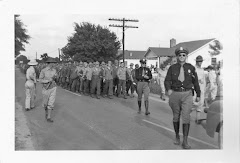
I heard this week from a man who grew up in Aliceville. He remembers being a young boy at West End Baptist Church and seeing the German prisoners march by the church, with their goose step rhythm, on their way from the train station to the camp. Like many Aliceville residents during WWII, this man's father was an employee at the camp.
After the camp closed at the end of the war, he remembers swimming in the pool that was still open on the POW camp grounds. When he was a senior in high school, he played football on the new sports field that was built near where the Officers Club had once stood. He also played baseball there when he was in college.
NOTE: Fox6 News in Birmingham will broadcast a feature about Aliceville and its Veterans Day celebration on the its 10:00 PM broadcast on Monday, November 12.
After the camp closed at the end of the war, he remembers swimming in the pool that was still open on the POW camp grounds. When he was a senior in high school, he played football on the new sports field that was built near where the Officers Club had once stood. He also played baseball there when he was in college.
NOTE: Fox6 News in Birmingham will broadcast a feature about Aliceville and its Veterans Day celebration on the its 10:00 PM broadcast on Monday, November 12.
Subscribe to:
Posts (Atom)


 Posts
Posts