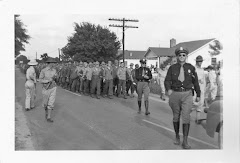
A reader of Guests Behind the Barbed Wire e-mailed last week to say that he has been a WWII history buff for many years. Although his interest centers on the European Theater, he would like more information about two German POW camps in the United States during WWII. One of them was in Hanover, PA, and the other in Stewartstown, a small town south of York, PA.
If anyone has information about either of these camps, please let me know. I will be happy to put you in touch with this reader.
Friday, September 28, 2007


Escaped POW Opened Bookstore in Chicago
One of the more interesting stories I've come across since finishing Guests Behind the Barbed Wire is that of Reinhold Pabel. Pabel was a member of the 115th Panzer Grenadiers who was captured and sent to a POW camp in Illinois. He escaped in 1945, made his way to Chicago, and eventually became the quiet proprietor of a bookstore on Chicago's North Side under the name of Philip Brick. He was captured by the FBI in 1953 and, after many headlines, returned to Germany.
Jim Reed, owner of Reed Books: The Museum of Fond Memories in downtown Birmingham, Alabama, told me about the book Pabel wrote about his experiences--Enemies Are Human--and sold me a copy of the out-of-print volume. It was fascinating reading, and Jim wondered out loud what had ever happened to Pabel. I was curious, too, and found an article on the Internet in a Chicago-style "what ever happened to" column.
It turns out Antiquariat Reinhold Pabel is still in the book business, now in Hamburg, Germany. His motto is, "Name the book--We'll get it!" and the website for his bookstore carries the following notice at the bottom: Gegruendet 1948 in Chicago, Illinois (founded in 1948 in Chicago, Illinois).
Jim Reed, owner of Reed Books: The Museum of Fond Memories in downtown Birmingham, Alabama, told me about the book Pabel wrote about his experiences--Enemies Are Human--and sold me a copy of the out-of-print volume. It was fascinating reading, and Jim wondered out loud what had ever happened to Pabel. I was curious, too, and found an article on the Internet in a Chicago-style "what ever happened to" column.
It turns out Antiquariat Reinhold Pabel is still in the book business, now in Hamburg, Germany. His motto is, "Name the book--We'll get it!" and the website for his bookstore carries the following notice at the bottom: Gegruendet 1948 in Chicago, Illinois (founded in 1948 in Chicago, Illinois).
Tuesday, September 11, 2007
Searching for Passengers on the Henry Baldwin 1944
After my essay on Camp Aliceville appeared in The Anniston Star, I heard from a man in Eastaboga, Alabama, who is searching for former German POWs who might remember making the Atlanta crossing on a Liberty Ship named the Henry Baldwin. He says they picked up 350 German POWs in Algiers and discharged them in Newport News, Virginia about May 23, 1944.
If the name of this ship sounds familiar to any of my readers, please let me know by e-mail, and I will put you in touch with this man.
The Liberty ships carried supplies to American troops in Europe and then carried POWs (mostly Germans) back to camps in the US during WWII. There are numerous memories about those crossings--how crowded the ships were, how they tossed and turned sideways and front to back, sleeping in hammocks in the hold, eating pretty well, and wondering where on earth they were headed, and what would happen when they got there.
If the name of this ship sounds familiar to any of my readers, please let me know by e-mail, and I will put you in touch with this man.
The Liberty ships carried supplies to American troops in Europe and then carried POWs (mostly Germans) back to camps in the US during WWII. There are numerous memories about those crossings--how crowded the ships were, how they tossed and turned sideways and front to back, sleeping in hammocks in the hold, eating pretty well, and wondering where on earth they were headed, and what would happen when they got there.
Sunday, September 9, 2007
Words from Germany
An e-mail arrived this month from one of the former German POWs who was held in Camp Aliceville during WWII. The e-mail was in English, and his English is on about the same level as my German--readable and understandable, with a few quirks here and there.
Wilhelm wrote that he has been reading Guests Behind the Barbed Wire with great pleasure, while keeping his German to English dictionary to hand. I smiled when I read this, because while writing the book, whenever I wanted to communicate with one of the former POWs, I definitely kept my English to German dictionary to hand.
Wilhelm wrote that Walter, another former POW, has told him he keeps his copy of Guests on his writing table and goes back to it frequently. Wilhelm also expressed the thought that it is a shame so many others of their war comrades have passed away and cannot read the book.
Finally, he wrote that he thinks often about Aliceville and especially about what he calls his "hospitable house," which is the home of a couple named Chuck and Jane who have been his and his family's gracious hosts on several occasions when they have returned for visits and reunions. He also said he thinks often about Mary Bess, whom he describes as "the soul of the museum." (This is the Aliceville Museum in Aliceville, Alabama, which is a wonderful repository for records having to do with Camp Aliceville.)
Wilhelm wrote that he has been reading Guests Behind the Barbed Wire with great pleasure, while keeping his German to English dictionary to hand. I smiled when I read this, because while writing the book, whenever I wanted to communicate with one of the former POWs, I definitely kept my English to German dictionary to hand.
Wilhelm wrote that Walter, another former POW, has told him he keeps his copy of Guests on his writing table and goes back to it frequently. Wilhelm also expressed the thought that it is a shame so many others of their war comrades have passed away and cannot read the book.
Finally, he wrote that he thinks often about Aliceville and especially about what he calls his "hospitable house," which is the home of a couple named Chuck and Jane who have been his and his family's gracious hosts on several occasions when they have returned for visits and reunions. He also said he thinks often about Mary Bess, whom he describes as "the soul of the museum." (This is the Aliceville Museum in Aliceville, Alabama, which is a wonderful repository for records having to do with Camp Aliceville.)
Friday, August 31, 2007
Songs and Soft Drinks
Just returned from a water aerobics class where two friends said they'd recommended Guests Behind the Barbed Wire to their neighbor. I told them about the letter I received this week from the Japanese-American gentleman from Honolulu who guarded German POWs from Camp Aliceville while they harvested peanuts during WWII.
They liked the image of the German prisoners singing the Coke jingle through the fence to their Japanese guards. Hm-mm, said one of my water buddies. It would have been so much simpler if, instead of a war, they'd all just had a Coke together--the Germans, the Japanese, and the Americans, and been done with it.
Too bad international politics isn't just that simple.
They liked the image of the German prisoners singing the Coke jingle through the fence to their Japanese guards. Hm-mm, said one of my water buddies. It would have been so much simpler if, instead of a war, they'd all just had a Coke together--the Germans, the Japanese, and the Americans, and been done with it.
Too bad international politics isn't just that simple.
Thursday, August 30, 2007
Peanuts, POWs--and Japanese guards??
Yesterday I received a letter from a gentleman in Honolulu, Hawaii who was a member of Company L in the 442nd Regimental Combat Team during WWII. Most history buffs know that the 442nd was a unit of Japanese Americans formed in February 1943 from among second generation Japanese-American citizens in Hawaii and Japanese volunteers from the internment camps set up inland from the west coast in 1942. These men became a cohesive military unit that fought valiantly for their country, the USA, in North Africa and Europe and were honored with a White House ceremony after the war.
It is probably not so widely known that one of the first assignments for Company L of this combat unit created an unusual juxtaposition for WWII. In August 1943, after completing basic training at Camp Shelby in Mississippi, members of the 442nd were ordered over to Camp Aliceville in Alabama to guard German POWs being sent down to Dothan for the annual peanut harvest.
It must have seemed ironic and amusing to local residents to see crews of ten German POWs, guarded by three Japanese Americans, headed out to the peanut fields each morning that fall.
The gentleman from Honolulu graciously shared some of his memories of that experience:
1. He watched the Germans, many of whom had been members of Erwin Rommel's Afrikakorps, digging up the peanut plants and stacking them on 7 to 8 foot poles so the peanuts could dry before picking.
2. He remembers that the German POWs were kept in fenced-in compounds at night after their work. They would come to the fence each evening after dinner and sing songs to their Japanese guards who had gathered on the other side of the fence. One song they sang had a chorus (probably a yodel) that he remembered as sounding like, "Hi Lai Lai de Hi Lai Lai."
3. When Company L of the 442nd created their company song entitled "Go for Broke," they used the chorus they'd heard the German POWs singing as part of their song. Down through the years, this song--including the "German" chorus--has been sung by veterans at various functions. (If anyone is interested, I have a copy of this combat team company song.)
4. He also remembers another song the German POWs sang to their Japanese guards in a teasing sort of way. He says it was actually the "Ice Cold Coca-Cola" jingle, but very funny pronounced in German accents. Coca-Cola was a regular part of the soft drink diet in POW camps across the country.
War creates many strange juxtapositions. Wonder what would happen if the generals from one side could share music with the generals on the other side.
It is probably not so widely known that one of the first assignments for Company L of this combat unit created an unusual juxtaposition for WWII. In August 1943, after completing basic training at Camp Shelby in Mississippi, members of the 442nd were ordered over to Camp Aliceville in Alabama to guard German POWs being sent down to Dothan for the annual peanut harvest.
It must have seemed ironic and amusing to local residents to see crews of ten German POWs, guarded by three Japanese Americans, headed out to the peanut fields each morning that fall.
The gentleman from Honolulu graciously shared some of his memories of that experience:
1. He watched the Germans, many of whom had been members of Erwin Rommel's Afrikakorps, digging up the peanut plants and stacking them on 7 to 8 foot poles so the peanuts could dry before picking.
2. He remembers that the German POWs were kept in fenced-in compounds at night after their work. They would come to the fence each evening after dinner and sing songs to their Japanese guards who had gathered on the other side of the fence. One song they sang had a chorus (probably a yodel) that he remembered as sounding like, "Hi Lai Lai de Hi Lai Lai."
3. When Company L of the 442nd created their company song entitled "Go for Broke," they used the chorus they'd heard the German POWs singing as part of their song. Down through the years, this song--including the "German" chorus--has been sung by veterans at various functions. (If anyone is interested, I have a copy of this combat team company song.)
4. He also remembers another song the German POWs sang to their Japanese guards in a teasing sort of way. He says it was actually the "Ice Cold Coca-Cola" jingle, but very funny pronounced in German accents. Coca-Cola was a regular part of the soft drink diet in POW camps across the country.
War creates many strange juxtapositions. Wonder what would happen if the generals from one side could share music with the generals on the other side.
Monday, August 27, 2007
Aliceville Native Remembers II
An Aliceville native whose father owned a gasoline distribution business was drafted (late in life) during World War II. When he shipped out, his wife took over delivering gasoline to Camp Aliceville. It was that kind of time.
Aliceville was founded by a group of Scottish immigrants who traveled to wherever land was free or very cheap. They migrated together to Ireland, then Pennsylvania, South Carolina, Georgia, and then Alabama. Some went on to Louisiana and then Texas.
Aliceville was founded by a group of Scottish immigrants who traveled to wherever land was free or very cheap. They migrated together to Ireland, then Pennsylvania, South Carolina, Georgia, and then Alabama. Some went on to Louisiana and then Texas.
Subscribe to:
Posts (Atom)


 Posts
Posts