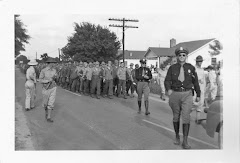
I am pleased to post below a review of Guests Behind the Barbed Wire that appeared this morning on amazon.com. It is written by the daughter of Jack Sisty, one of several guards at Camp Aliceville who fell in love with and married young women in the Pickens County area and later returned to Aliceville to make their home:
A Daughter of the Camp, December 30, 2007 I grew up in Aliceville, Alabama, and enjoyed almost idyllic childhood and teenage years there. I am a product of Camp Aliceville. My father was a native of Long Island, New York. He tried many times to enlist in the Army at the beginning of the war, but was turned down because he had a permanent limp from polio as an infant and a ruptured eardrum. Finally, he was allowed to enlist and was sent directly to Aliceville, Alabama, a GI at the prisoner of war camp. There he met my mother, a member of an old family in the area, who was one of the many young women who left their jobs to work at the camp; it was an exciting time for them, a chance to do something completely unexpected, and a chance to serve their country. My Mom and Dad met, courted, and married on one of my Dad's three-day passes. They lived briefly in New York, where my brother and I were born, then moved back to Alabama, to stay. I grew up listening to stories about the camp. Until recently, the history of Camp Aliceville has been largely unknown to the rest of the country. It is wonderful that more people will be made aware of the happenings there, thanks to Ms. Cook and her excellently researched and well-written book. Aliceville became richer because of the influx of GI's from all over the country, many who remained in Aliceville after the war. Aliceville became rich in culture and history, and its citizens developed a great appreciation for the arts and literature. Above all, Aliceville did exhibit a great example of the Golden Rule. It is to our credit that POW's were treated humanely and with respect - things that did not always happen in countries where our veterans were held as prisoners.
Sunday, December 30, 2007


Wednesday, December 26, 2007
A Serendipity of Friendship
During the Christmas season, I heard from Mary Lu Keef who was once the eight-year-old little girl who gave me many insights into life at Camp Aliceville during World War II. She wrote, "I have to tell you that, as a result of your book, I heard from two former Aliceville classmates that I had not seen or heard from since we moved away (from Aliceville) in 1945! Thanks to e-mail, I am now in contact with them."
In 1942, Mary Lu's family moved from New York state to Alabama so her father could take a civilian employee position at Camp Aliceville during the war. Her mother also worked at the camp hospital, and Mary Lu attended Aliceville Elementary School during that time. It was quite a change of culture and experience.
Mary Lu also wrote that she had recently found her father's Camp Aliceville pass and other ID cards belonging to him at the time of the war. She is considering visiting Aliceville in May 2008, when former German POW Hermann Blumhardt may visit with his friend John Gaffey. Hermann's wife Katie, who also provided many memories and insights for the book, was hospitalized a few months ago with a heart problem, but she has made a successful recovery and plans to visit their children in Michigan in May.
In 1942, Mary Lu's family moved from New York state to Alabama so her father could take a civilian employee position at Camp Aliceville during the war. Her mother also worked at the camp hospital, and Mary Lu attended Aliceville Elementary School during that time. It was quite a change of culture and experience.
Mary Lu also wrote that she had recently found her father's Camp Aliceville pass and other ID cards belonging to him at the time of the war. She is considering visiting Aliceville in May 2008, when former German POW Hermann Blumhardt may visit with his friend John Gaffey. Hermann's wife Katie, who also provided many memories and insights for the book, was hospitalized a few months ago with a heart problem, but she has made a successful recovery and plans to visit their children in Michigan in May.
Sunday, November 25, 2007
Camp Stewartstown--Mixed Emotions
A reader in Pennsylvania has sent along a clipping from the November 11, 2007 edition of the York, PA Sunday News entitled "Enemy." This article profiles a 15-acre POW enclosure set up at the playground in Stewartstown, Pennsylvania. It was in operation from June 30, 1944 to October 31, 1945 and housed nearly 2,000 Austrian and German prisoners of war in an area that, before the war, offered space for Sunday School picnics, fairs, and carnivals. Residents had used some of the land at the playground for Victory Gardens during the war.
The southern portion of York County, PA has many orchards and canneries, so the POWs were welcome as workers there, especially during harvest season.
It is interesting to note that York County had once before been home to POWs--from 1781 to 1783 during the American Revolution when British captives were held at Camp Security in what is now Springettsbury Township.
The York newspaper article notes that some residents believed the POWs were not guarded well enough and that they were treated too well. Others viewed them as "just boys, like county youth fighting overseas."
One resident wrote at the time, "Pity would rise in our hearts as we thought of them so far from their homeland. Then we remembered the hometown boys fighting and dying on foreign soil, in a war started by their leader--and one would then feel almost like a traitor."
These same sentiments could easily have been expressed by many people in Aliceville, Alabama, at that time.
The southern portion of York County, PA has many orchards and canneries, so the POWs were welcome as workers there, especially during harvest season.
It is interesting to note that York County had once before been home to POWs--from 1781 to 1783 during the American Revolution when British captives were held at Camp Security in what is now Springettsbury Township.
The York newspaper article notes that some residents believed the POWs were not guarded well enough and that they were treated too well. Others viewed them as "just boys, like county youth fighting overseas."
One resident wrote at the time, "Pity would rise in our hearts as we thought of them so far from their homeland. Then we remembered the hometown boys fighting and dying on foreign soil, in a war started by their leader--and one would then feel almost like a traitor."
These same sentiments could easily have been expressed by many people in Aliceville, Alabama, at that time.
Thursday, November 8, 2007
Former Resident Remembers Camp Aliceville--During and After
I heard this week from a man who grew up in Aliceville. He remembers being a young boy at West End Baptist Church and seeing the German prisoners march by the church, with their goose step rhythm, on their way from the train station to the camp. Like many Aliceville residents during WWII, this man's father was an employee at the camp.
After the camp closed at the end of the war, he remembers swimming in the pool that was still open on the POW camp grounds. When he was a senior in high school, he played football on the new sports field that was built near where the Officers Club had once stood. He also played baseball there when he was in college.
NOTE: Fox6 News in Birmingham will broadcast a feature about Aliceville and its Veterans Day celebration on the its 10:00 PM broadcast on Monday, November 12.
After the camp closed at the end of the war, he remembers swimming in the pool that was still open on the POW camp grounds. When he was a senior in high school, he played football on the new sports field that was built near where the Officers Club had once stood. He also played baseball there when he was in college.
NOTE: Fox6 News in Birmingham will broadcast a feature about Aliceville and its Veterans Day celebration on the its 10:00 PM broadcast on Monday, November 12.
Friday, October 5, 2007
Remembering Picnics at Lubbubb Creek
My e-mail this week included a heartwarming surprise from the daughter of an Aliceville resident whose mother met and married one of the American officers in charge of Camp Aliceville during WWII. She wrote as follows:
"All of my life I heard stories about 'the camp' and was so delighted to find your book. I have been reading the book to (my elderly mother) and it has brought back so many memories. She vividly remembers the day the first train pulled into the station and the soldiers marched down the street singing--that's one of the stories she told over the years. She always said they looked so bedraggled, but their voices were so strong. I can read a name and she'll remember some little piece of gossip that she hasn't thought about in years! She loved remembering the picnics at Lubbubb Creek, for instance, AND I had always wondered but never knew until your book, what the distinct smell was in the old school sawdust (oiled sawdust). It has been so healing for my mother to relive those years through your lovely book. Thank you so much for giving my mother such a wonderful gift during this last stage of her life."
"All of my life I heard stories about 'the camp' and was so delighted to find your book. I have been reading the book to (my elderly mother) and it has brought back so many memories. She vividly remembers the day the first train pulled into the station and the soldiers marched down the street singing--that's one of the stories she told over the years. She always said they looked so bedraggled, but their voices were so strong. I can read a name and she'll remember some little piece of gossip that she hasn't thought about in years! She loved remembering the picnics at Lubbubb Creek, for instance, AND I had always wondered but never knew until your book, what the distinct smell was in the old school sawdust (oiled sawdust). It has been so healing for my mother to relive those years through your lovely book. Thank you so much for giving my mother such a wonderful gift during this last stage of her life."
Tuesday, October 2, 2007
Herbert Jogerst POW Sculptor
A few weeks ago I heard from Michael Rutherford, a historian in Tell City, Indiana who shared a great deal of information about the Indiana Cotton Mills in Cannelton, Indiana, when I was working on my first book, North Across the River. Rutherford had read my new book and sent along an interesting packet of information about a German POW named Herbert Jogerst who was held at Camp Breckenridge in Kentucky.
Jogerst had studied art and sculpture in Strassburg before being drafted in WWII. His military service in the German army took him to Greece, Bulgaria, Romania, and eventually North Africa, where he was captured near Metaches El Bab. In an interview conducted by Gerhard Auer and translated by Sister Ruth Ellen Doane, Jogerst describes his first treatment as a POW. "We were loaded into stockcars....We were collapsing of thirst. There were comrades who were willing to give away their entire fortunes if they could only have a drink. Some soldiers became insane due to thirst."
He describes being transported in this manner through North Africa. "Sometimes we were shot at through the closed wagon (train car) or our guards pushed their bayonettes through the slits in the wagon walls. That was hell. In Casablance we were handed over to the English. Then, for the first time, we were treated as people."
He was sent by ship to Canada and then by train "in Pullman-type cars which were comfortably equipped express train cars" to Kentucky. At Camp Breckenridge, he and 3,000 other POWs kept the streets and barracks clean at a military installation where thousands of American soldiers were being trained.
Jogerst says camp life was monotonous at first. Because he could draw good letters, he became a sign painter and also tried to paint portraits when he had paints. "As the Americans noticed that I was able to paint, my fortune changed," he told the interviewer. One day a guard came to him and said, "The wall in our Mess Hall is so bare. Could you paint something for it?" His fellow prisoners asked him to paint scenery for a theatrical play, which he did in secrecy at night until guards discovered him missing at late hours from his barracks. When these watchmen saw his work, however, they gave him permission to paint without restriction and even commissioned him to paint the altar in the camp chapel.
During his time in Camp Breckenridge, Jogerst was given a barracks to use as a studio and instructed other POWs in calligraphy and figure drawing. When a music pavilion was built by the POWs for their concerts, he built a fountain for it. While others played chess in the evenings, he worked with piles of stone to built the fountain.
One of his most interesting encounters was with the well-known press photographer Alfred Eisenstett (who was Jewish and had worked for the Berliner Illustrierte magazine in Germany before emigrating to the US). Eisenstett was creating a picture report about German POWs for Life Magazine when he visited Camp Breckenridge. When shown the many paintings Jogerst had created, the photographer asked the artist what he planned to do with them. Eisenstett wrote in his article that Jogerst replied, "One day someone will take them away from me."
Among the responses to this article, Life received letters from more than 2,000 readers who wanted to help this German POW preserve his work. As a result, Life placed six overseas trunks at Jogerst's disposal. He was able to send more than 300 of his paintings and carvings home to his mother for safe keeping.
Monks at the Monastery at St. Meinrad (in southern Indiana) http://www.saintmeinrad.edu/ also saw Jogerst's work and took him to the monastery to work as a sculptor until he was sent back to Germany in 1947. When he returned to Germany, Jogerst bought his mother a house and helped her start a grocery business. Then he returned to the US, where he remained until 1962, doing sculpture work at St. Meinrad and also creating statues, baptismal fonts, and altars that can now be found in 28 American states. See also http://www.ctk.org/church-history.htm and http://www.stspeterandpaul.net/parish/history/historical-society/487.php.
Herbert Jogerst died in Germany on April 3, 1993, shortly before a large group of tourists from his hometown of Waghurst came to the US on a trip. Among them was his son Elmar who was able to see much of his father's work for the first time. That work includes an eleven-foot, 6,200 pound statue known to southern Indiana residents as "Christ of the Ohio" because it stands on Fulton Hill at Troy, Indiana, overlooking the Ohio River.
I have in my files the translation of the entire interview with Jogerst, along with excerpts from the History of St. Meinrad ArchAbbey, which contains photos of some of Jogerst's work, and also news clippings from his son's visit. If anyone would like copies, please let me know.
Jogerst had studied art and sculpture in Strassburg before being drafted in WWII. His military service in the German army took him to Greece, Bulgaria, Romania, and eventually North Africa, where he was captured near Metaches El Bab. In an interview conducted by Gerhard Auer and translated by Sister Ruth Ellen Doane, Jogerst describes his first treatment as a POW. "We were loaded into stockcars....We were collapsing of thirst. There were comrades who were willing to give away their entire fortunes if they could only have a drink. Some soldiers became insane due to thirst."
He describes being transported in this manner through North Africa. "Sometimes we were shot at through the closed wagon (train car) or our guards pushed their bayonettes through the slits in the wagon walls. That was hell. In Casablance we were handed over to the English. Then, for the first time, we were treated as people."
He was sent by ship to Canada and then by train "in Pullman-type cars which were comfortably equipped express train cars" to Kentucky. At Camp Breckenridge, he and 3,000 other POWs kept the streets and barracks clean at a military installation where thousands of American soldiers were being trained.
Jogerst says camp life was monotonous at first. Because he could draw good letters, he became a sign painter and also tried to paint portraits when he had paints. "As the Americans noticed that I was able to paint, my fortune changed," he told the interviewer. One day a guard came to him and said, "The wall in our Mess Hall is so bare. Could you paint something for it?" His fellow prisoners asked him to paint scenery for a theatrical play, which he did in secrecy at night until guards discovered him missing at late hours from his barracks. When these watchmen saw his work, however, they gave him permission to paint without restriction and even commissioned him to paint the altar in the camp chapel.
During his time in Camp Breckenridge, Jogerst was given a barracks to use as a studio and instructed other POWs in calligraphy and figure drawing. When a music pavilion was built by the POWs for their concerts, he built a fountain for it. While others played chess in the evenings, he worked with piles of stone to built the fountain.
One of his most interesting encounters was with the well-known press photographer Alfred Eisenstett (who was Jewish and had worked for the Berliner Illustrierte magazine in Germany before emigrating to the US). Eisenstett was creating a picture report about German POWs for Life Magazine when he visited Camp Breckenridge. When shown the many paintings Jogerst had created, the photographer asked the artist what he planned to do with them. Eisenstett wrote in his article that Jogerst replied, "One day someone will take them away from me."
Among the responses to this article, Life received letters from more than 2,000 readers who wanted to help this German POW preserve his work. As a result, Life placed six overseas trunks at Jogerst's disposal. He was able to send more than 300 of his paintings and carvings home to his mother for safe keeping.
Monks at the Monastery at St. Meinrad (in southern Indiana) http://www.saintmeinrad.edu/ also saw Jogerst's work and took him to the monastery to work as a sculptor until he was sent back to Germany in 1947. When he returned to Germany, Jogerst bought his mother a house and helped her start a grocery business. Then he returned to the US, where he remained until 1962, doing sculpture work at St. Meinrad and also creating statues, baptismal fonts, and altars that can now be found in 28 American states. See also http://www.ctk.org/church-history.htm and http://www.stspeterandpaul.net/parish/history/historical-society/487.php.
Herbert Jogerst died in Germany on April 3, 1993, shortly before a large group of tourists from his hometown of Waghurst came to the US on a trip. Among them was his son Elmar who was able to see much of his father's work for the first time. That work includes an eleven-foot, 6,200 pound statue known to southern Indiana residents as "Christ of the Ohio" because it stands on Fulton Hill at Troy, Indiana, overlooking the Ohio River.
I have in my files the translation of the entire interview with Jogerst, along with excerpts from the History of St. Meinrad ArchAbbey, which contains photos of some of Jogerst's work, and also news clippings from his son's visit. If anyone would like copies, please let me know.
Monday, October 1, 2007
German POWs in Owosso, Michigan, too.
I love the seredipity of the writing world and the connections that pop up in unexpected places. I heard this morning from Gary Slaughter who will introduce me at the Southern Festival of Books in Nashville, Tennessee, in two weeks. Gary has written a series of novels set in Michigan during the last year of World War II. The first of these involves two young women who are charged with treason and brought to trial for helping two German POWs escape from a camp. This novel is a fictionalized account of events that actually transpired in Owosso, Michigan, where Gary grew up. For more information on the Owosso camp, see http://www.sdl.lib.mi.us/history/pow_camp.html
Ever since he was a boy, Gary has been fascinated by the subject of the German POWs and has read extensively about them. Like me, he has a small library of books on the subject. I am looking forward to meeting him, reading his novel (Cottonwood Summer--Fletcher House), and comparing notes. http://www.garyslaughter.com/
In his letter this morning, Gary did admit to being a graduate of the University of Michigan, which makes him a Wolverine, and said he understood that that made him a "natural enemy" of any Ohio State graduate who is a Buckeye like me. He did say, though, that he had "forgiven worse in people" and hoped I would do the same for him. Since I have a brother who is a graduate of Michigan State University, I already have practice with this and will certainly do the same.
Ever since he was a boy, Gary has been fascinated by the subject of the German POWs and has read extensively about them. Like me, he has a small library of books on the subject. I am looking forward to meeting him, reading his novel (Cottonwood Summer--Fletcher House), and comparing notes. http://www.garyslaughter.com/
In his letter this morning, Gary did admit to being a graduate of the University of Michigan, which makes him a Wolverine, and said he understood that that made him a "natural enemy" of any Ohio State graduate who is a Buckeye like me. He did say, though, that he had "forgiven worse in people" and hoped I would do the same for him. Since I have a brother who is a graduate of Michigan State University, I already have practice with this and will certainly do the same.
Subscribe to:
Posts (Atom)


 Posts
Posts