Thursday, March 5, 2009

Former 442nd POW Guard Sends Greetings


When I sent Mr. Genro Kashiwa a copy of the photo showing a Japanese American soldier guarding German POWs during WWII (see "Alabama Mosaic....October 10, 2008 and "Peanuts, POWs....August 30, 2007)), he sent along this Christmas photo of himself with his wife and grandsons in Honolulu. He also sent a copy of their family Christmas letter for 2008, which mentioned his activities with other members of the 442nd company he once belonged to.
The 442nd is the most decorated regimental combat team in United States military history and was composed primarily of Japanese-Americans from Hawaii and the mainland. Their courageous service to our country continues to be an example of patriotism against great odds.


The newsletter notes that the Honolulu contingent of these World War II veterans still gather for monthly meetings, but everyone in their group is now in their 80s, and many have passed away. "As the group grows smaller," Mr. Kashiwa writes, "the close friends who remain are all the more precious to us, and we look forward to visiting with them every month."


The Kashiwas live with their daughter and her husband and their grandsons, Jason, Bradley, and Kevin. Jason's marching band recently went to Washington, D. C. to participate in the inauguration of President Obama.
What an amazingly varied history this wonderful country has!

Monday, January 5, 2009

Daughter of Aliceville Guard Reviews Book

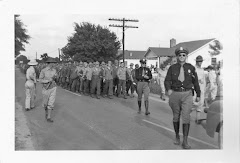
This is what downtown Aliceville looked like when twenty-year-old Stanley Pendrak arrived in May 1943 to help guard German POWs. Stan was a native of New York state who, before World War II, had never left the northern town where he was born.

As an army sergeant at Camp Aliceville, Stan was in a company that escorted POWs from the train in June 1943. He worked in the camp mess hall as first cook until late in the war.


One day, Jeanne Holliday took a break from her job at the Aliceville Hotel beauty shop to get a cup of coffee. "I just followed her," Stan told me in an interview. "I started talking to her and invited her to the bowling alley. We just went together from that."


After the war, Stan and Jeanne made their home in Aliceville and raised their family there. This week, I was delighted to discover a review of Guests Behind the Barbed Wire written by the Pendraks' daughter for amazon.com. She writes that, as a child, she was sheltered enough not to be greatly aware of the German POW story unfolding around her. She also notes that, when her father passed away in October 2007, he was the last living Aliceville resident who had served at Camp Aliceville.


"I feel so honored to have been raised in a town that truly embodies 'a slice of Americana,'" she writes. She describes her father as a 'misplaced Yankee' who ended up in the South and embraced Aliceville after meeting the love of his life there. She is grateful to have the legacy of her parents' story, as told in Guests, to share with her own grandchildren.

Pendrak's daughter notes that the book has enriched her knowledge of just how special Aliceville was and still is today, "...one small town that shone brightly through its caring residents, its contribution to the basic values that have made our country great, and service to our nation during 'the war to end all wars.'"
Thanks so much to this proud daughter of Aliceville for sharing her thoughts.

Wednesday, December 10, 2008

Alabama Mosaic is a wonderful visual resource.


The photo at left shows a Japanese-American soldier guarding German POWs during a peanut harvest in Barbour County, Alabama during WWII. It is part of a wonderful resource--an electronic archive of photos and documents from all eras of Alabama history called Alabama Mosaic.
Photo by Draffus L. Hightower, Clayton Historical Preservation Authority Collection, University of South Alabama Archives. Thousands of similar vintage images are available at USA Archives at www.usouthal.edu/archives/


In my book, Guests Behind the Barbed Wire, I wrote about the Japanese-American guards who took prisoners down to Dothan for the peanut harvest (after they didn't do very well picking cotton), but I had never seen this photo before.

If you'd like to see more wonderful photos of Alabama history, be sure to also check the Alabama Mosaic website. It is at http://www.alabamamosaic.org/.


Friday, December 5, 2008

Blount County Program on German POWs

In early November, I made a trip up to Cleveland, Alabama to present a talk and slide show about Guests Behind the Barbed Wire to members of the Blount County chapter of Delta Kappa Gamma (education honorary). After a wonderful catered Thanksgiving-style dinner, the group gathered in the sanctuary of the First Baptist Church.


I'd never been to Cleveland, Alabama before, but I thoroughly enjoyed the evening and the many interesting people I met. My sincere thanks to Vivian Haley (see photo) for inviting me. I grew up in the Cleveland, Ohio area, and as I told the the group that evening, when I first moved to Alabama in 1970, people often asked me where I was from (as soon as they heard my northern accent). When I answered "Cleveland," they would invariably ask if I meant Cleveland, Alabama or Cleveland, Tennessee. The big city on Lake Erie did not immediately come to mind for them as it did for me. Thanks, too, to my friend Ruth Breipohl for riding with me that evening and handling the busy book sales after the talk.

I'd also like to thank Jim Kilgore for the wonderful article he wrote about the program for The Blount Countian. It was published in their November 26 issue, and reading it made me so glad that we still have such excellent community newspapers in our state. It is a very well-written story. Often, when I read newspaper accounts of a talk I've given, I hardly recognize what I actually said! Jim's account was accurate and thoughtful, and I believe he'd even read the book.


I've posted Jim's story below because I think, perhaps better than any other article I've read, it captures the essence of the message I hoped this book would convey.


Alabama World War II prisoner of war camps reclaim spotlight by Jim Kilgore

Juanita (left) and Marlin Beasley and Ruth Beaumont Cook pose after Cook's book talk at Cleveland's First Baptist Church. The local Beta Chapter of the women's educational sorority Delta Kappa Gamma hosted Cook, who reviewed her latest book, Guests Behind the Barbed Wire.
"For not with swords loud clashing, Nor roll of stirring drums; With deeds of love and mercy, The heavenly kingdom comes," so Ruth Beaumont Cook introduces her book Guests Behind the Barbed Wire. That thought, from Ernest Warburton Shurtleff's hymn "Lead On O King Eternal," echoes throughout Cook's work.
The Ohio native and nearly 40-year Alabama resident offers insight into a fascinating but littleknown segment of Alabama's and the nation's World War II history. Cook spends over 550 pages sharing selected stories of Americans and Germans who lived in wartime Aliceville, Alabama.
As the site of the largest German prisoner of war camp in the United States, Aliceville and its residents came to be touched forever by that experience. The book highlights a few of the over 6,000 men interned in the west Alabama facility, including POWs, prison guards, and other officers who came to Aliceville, some of whom decided to make that their eventual home. Many area residents also found well-paying jobs at the camp. Three of the Germans profiled eventually returned to the United States and became American citizens; another's German obituary proclaimed him an honorary citizen of Alabama; still others, their children and grandchildren have returned to Aliceville to commemorate the up to three year experience.

The ginkgo peace tree weocomes vititors to the Aliceville POW Museum and Cultural Center courtyard. Statues prepared by the POWs lie in the background.
As Cook spoke recently at Cleveland's First Baptist Church, she relayed the story of a daughter of one former POW. Addressing an Alabama reunion celebration, the woman noted that German POWs captured by Russian forces told of eating cockroaches to stay alive. Her father spoke of preparing doughnuts on Sunday afternoons in his Aliceville barrack's kitchen.
The book shares from letters sent to Aliceville residents after the war and of granted requests for supplies forwarded to those who, at times, had taken arms against the givers' homeland. Readers may hardly believe the generosity of a nation to its enemy combatants. The story somehow lifts one to a new appreciation of the nobility of a victorious nation in what the late Studs Terkel called "The [last] Good War."
Cook, in her Cleveland presentation, spoke of the curiosity of Aliceville residents with the first arrival of the POWs. Juanita Prisock Beasley and her husband Marlin were with Cook at the Beta Chapter Delta Kappa Gamma sponsored book talk. Beasley recalled that as a ten year-old she and other residents had disobeyed military orders to remain in their homes on that June 1943 day. Both she and Cook claim the Americans were eager to see these Nazi "supermen," most of whom were veterans of Erwin Rommel's famed Duetsches Afrikakorps. Many of the POWs said the town's people were there to see their horns. Cook contends most saw that day mere boys and felt sympathy for them.
She relates in her book that both the United States and Germany had signed the 1927 Geneva Prisoner of War accord. Under that agreement, POWs were to be treated as the capturing nation's own soldiers. To the United States that meant, among other things, that POWs were to live in barracks as their own soldiers; they were to receive the same food as American soldiers; they were to have recreational opportunities; and they were to be paid for each day of incarceration and additionally for any work they performed. Swiss and Red Cross observers made regular visits to assure conditions met with the accord.
The POWs had leisure time. Many pursued artistic, educational, musical, writing, or sports interests. They created an orchestra, a dance band, a greenhouse, and a newspaper. Money saved through canteen purchases funded most of these leisure activities. Some bargained with their guards or civilian employees for artistic supplies in exchange for drawings or paintings. They decorated their barracks, planted shrubbery, designed gardens, carved outdoor sculptures, built an outdoor orchestra shell, and made of their 120-barrack compounds a home-awayfrom home.
Cook touches on the very different experiences of Aliceville area soldiers captured by the Germans and Japanese and of some who died in that fight. Many Americans know of Japan's harsh treatment of all its prisoners. Neither Japan nor Russia had agreed to the Geneva accord. While Germany had signed, it did not adhere to the accord to the extent of the United States.
The Ohio State graduate contends that Americans had hoped word would reach Germany of their humane treatment of POWs. The thought was that Germany would reciprocate. There is no doubt Germany did not provide Americans with commensurate care. Some assert, however, that life for American POWS in German camps was immeasurably better than that for Russian POWs.
Idealistic Americans called for continued generosity toward the POWs. Cook includes a portion of a 1944 Collier's magazine editorial as substantiation.
We ought to be humane and generous in this mater because we are Americans, and because we have always believed as a nation in decency, humanity, humaneness and a break for the underdog - which war prisoners certainly are. If we should take to mal-treating war prisoners, we would betray something fine in our national make-up; and the consequences of that betrayal would kick back in our own teeth.
The well-researched and documented tome includes some stories Germans shared of their homeland experiences while husbands and fathers remained behind American barbed wire. It places personal stories in their historical period, reviewing events leading to prison captures and progress of the war over the life of the camp. It also deals with conditions after the war and the long delay many German POWs suffered before being allowed to return to their homes.
With the war's end, soldiers no longer qualified as POWs and found their lives changed. Officers no longer had the option of not working. America reduced food rations. Once most former POWs returned to Europe they found themselves forced to work in Great Britain, France, or elsewhere to help rebuild those war-torn nations for months or years before they were allowed to return home. Life became much less comfortable and pleasant than in their POW days.
In the late 1980s, Alabama Governor Guy Hunt issued a call for communities to make 1989 the year of "Come Home to Alabama." Cook says that in years prior to that call, strangers would appear in Aliceville and inquire around in German accented English, "Vhere is dah camp?"
Aliceville residents took Hunt's call to heart and invited their former "guests" to return to the onceagain sleepy town. With the help and encourage- ment of many in the United States and Germany, an official reunion for POWs, guards, and past and present residents came to fruition. Since that first occasion, others have followed. One Aliceville resident, who spent months in a German POW camp could not bring himself to share in the initial reunion. Eventually, he found the ability to meet with these former enemies.
Beyond the reunions, which have included at least one trip by some Americans to Germany, enthusiasm has grown for other commemorations. Some have lent or given prisoner-produced items they have held; POWs have donated copies of their newspapers; guards have shared of their newspapers; a former local soft-drink bottler donated its old plant; and now Aliceville has its own POW museum.
The United States government officially deactivated Camp Aliceville on Sept. 30, 1945. Governmental agencies or private individuals took possession of the camp buildings. The chimney for the enlisted men's club and a surrounding sidewalk in a small town park are all that most can find of this once amazing experiment.
One can find, at the museum, a small gingko tree planted by five former POWs. One who had been for years a reconstructed Nazi now prays for peace. He and others planted that tree, the first type to blossom at Hiroshima after the atomic bomb blast there, with the words, "This tree we now plant at this place. Let it be a symbol of hope for a peaceful future."
In her foreword, Cook reveals she spent time as a late teen as an exchange student in Germany. She found tremendous support there for America at the time. She recalls the tears Germans shed and their tremendous sympathy for America after 9/11. She writes with hope:
In January 2002, with the hunt for Osama bin Laden in full swing in Afghanistan,President Bush announced that captured members of Al Qaeda and the Taliban would not be protected by the Geneva Convention. He based his decision partly on advice from White House Counsel Alberto Gonzalez, who had concluded that these terrorists were not affiliated with a legal government and, therefore should not have rights or be considered military captives.
By that time, I'd read a great deal about the Geneva Convention standards followed with zeal by the United States during most of the World War II. I knew the very positive effects those standards had had on captives held in Camp Aliceville - the respect generated by simple things like hot coffee after a long journey; abundant meat and vegetables; adequate clothing and shelter; recreational, educational and spiritual opportunities - respect ongoing for a lifetime and now being shared with those captives children and grandchildren. I thought about the ginkgo tree former German POWs had planted in front of the Aliceville Museum as an expression of their profound belief in world peace.
The Oneonta Public Library has a copy of Cook's work. Some locals recall experiences they had of German POW out of a satellite camp in Oneonta. Others have spoken of still another camp at Cleveland. While the Aliceville museum has no record of the Cleveland camp, a Birmingham News article written by a Birmingham Southern college student does list the Oneonta site. Cook does explain in her book that the state had, at least, four base camps and 20 satellite ones, with over 17,000 total prisoners.
The review above dwells much on the serious side and with long-range implications. Obviously, any reviewer must limit the scope of the summary; rest assured, however, the book does have many lighter moments. Readers will find themselves chuckling at tales of the lax attitudes on the part of guards, soldiers, camp employees, townspeople and the POWs. They will also find poignant stories of the interned, those associated with the interned, and the two killed in reported escape attempts.
The Aliceville POW Museum and Cultural Center displays many items from the camp. Guests may reach the reach the museum from the Aliceville exit off I-59-20 south of Tuscaloosa.


Thursday, November 20, 2008

German POW Meier Now Buried in Chattanooga National Cemetery


After my last blog entry about the German POW who was shot during a supposed escape attempt from Camp Sutton, I received an interesting response from blogger "Camp Sutton," a retired US Army Master Sergeant in North Carolina who grew up next door to the camp and has become interested in researching its history.

Camp Sutton offered the following interesting information:

--Werner Friedrich Meier was originally buried at Camp Butner, but when that camp closed, his grave was moved to the Chattanooga National Cemetery.

--His grave marker there, as shown above, reads "1Sgt. Air Force" on the first line. The second line reads "German," and the third line lists as date of death, July 11, 1944," which corresponds with the date in newspaper reports for the German POW's death. This grave is located in Section PostC, Site 40-3.

Blogger Camp Sutton also shared the contents of a newspaper article that appeared in The Monroe Enquirer on July 13, 1944:

GERMAN PRISONER SHOT WHILE TRYING TO ESCAPE:
Former Luftwaffe Sergeant Killed By Camp Sutton Guards

A former Luftwaffe sergeant from the prisoner fo war compound at Camp Sutton was shot and killed by guards Tuesday morning during an attempted escape near Van Wyck, S.C.
He was Warner (sic) Friedrich Meier, a member of a group of Germans who have been working regularly in local woodpulp mills on government contracts made in accordance with Geneva convention regulations.
Two guard-escort soldiers of the group detailed as custodians of the working war-prisoners intercepted him in his attempted break and called upon to halt. After hesitating briefly, he continued his flight and they opened fir killing him at once.


Sunday, October 26, 2008

Carolina Newspaper Columnist Questions "Escape" Shooting of German POW


At left is a photo of Werner Meier, a sergeant (Feldwebel) in the Luftwaffe, who flew a Stuka Junkers 87 bomber in France and Russia before being sent to serve with German ground forces in North Africa. He was captured in early May 1943 and became one of the first 600 POWs sent to Camp Aliceville in Alabama. He spent almost a year in Aliceville and then was sent to Camp Sutton in North Carolina, where records show he was shot and killed on July 11, 1944, while trying to leave the camp. He was buried with military honors at Camp Buttner on July 13.


My friend and correspondent Gunther Wening, a relative of Meier's who lives in Holland, sent the above photo and other information while I was working on Guests Behind the Barbed Wire. This week Gunther sent me copies of two newspaper articles, written by Louise Pettus, that appeared in Carolina Gateway. Read together, the two articles add some puzzling details to the brief mention of Werner Meier in my book.


Pettus wrote that, during WWII, a man named Robert Vaughan drove a truck that was outfitted with benches and covered on top. It picked up POWs from Camp Sutton and took them to a farm near the village of Van Wyck that was owned by a Mr. Sachenmaer who owned a hosiery mill in Charlotte. One of his sons remembers the POWs tossing small bags of candy and gum to the local children. One POW gave Vaughan a handcarved replica of the ship that had brought him to America.


A man named David Alexander says a relative named Glenn Alexander, the farm manager at that time, told him it was prisoners who pointed out Werner Meier walking on the road--walking toward the work area, not away from it. Guards were patrolling the road in a Jeep. They fired twice, and Meier was killed. Mr. Alexander always believed Meier was trying to return to the camp, not run away from it.


A woman named Betty Broome, who was ten years old at that time, says she remembers being told that the prisoner had tried to escape, but she didn't think that made sense because he didn't know anyone in the area and didn't have any place to go.


Meier's relative, Gunther Wening, teaches German to students in Holland. He is thinking about writing short articles about World War II in his own region in Holland. He had this comment about the newspaper articles he sent:


"I am really astonished by the circumstances of Werner's death. Until now, everybody in the family had a picture in their mind of a fleeing and running away Werner Meier, who gets shot. I can hardly believe that somebody gets shot dead who walks on a street. I have been a soldier myself and can't understand why they shot immediately and there was something like a warning shot, but then again, I don't know the instructions the guards had and the exact situation."


If any of my readers would like copies of the two newspaper articles, please send me a comment with your e-mail or snail mail address, and I will send them along. If anyone has additional information about Werner Meier or about the circumstances of his death, please share that.

Tuesday, October 21, 2008

THICKET Magazine Features Aliceville POWs

The October/November issue of the new THICKET magazine has a story on page 75 entitled "Behind Enemy Lines." Based on my friend Stacey Torch's visit to the Spring 2007 reunion of former POWs, their guards, and members of the Aliceville community, the article includes interviews with Hermann Blumhardt, who was captured in North Africa in 1943, and Thomas Sweet, who served as a guard at Camp Aliceville during World War II.
Stacey quotes from letters written by POWs, thanking Aliceville residents for care packages sent to them and their families when they were desperate after the war. As Thomas Sweet told Stacey, his experience in Aliceville made him understand that "although other people may have a different nationality, they're the same as us. It never pays to judge people before you get to know them."

Looking back during the reunion, Sweet expressed what many people there were thinking and feeling when he said, "I've always said I have a soft spot in my heart for the people of Aliceville. You had to have been here to experience it to understand why."

If you'd like to read this article or others about "Alabama Redefined," as THICKET characterizes its theme, you can go to the magazine's website at http://www.thicketmag.com/.