Tuesday, December 15, 2009

Son Shares Photo of Captain Arthur John Klippen, M.D.

Those of you who have read Guests Behind the Barbed Wire probably remember the army captain who came to Camp Aliceville in December 1942 to set up the medical service for the POW camp. He took a room in the home of Miss Annie Mae Coleman over in Carrollton and began hiring hospital employees. One of the first was Elma Henders, who left college to become the Station Hospital dietician.

By mid-April 1943, Captain Arthur John Klippen, M. D., had the Station Hospital open and ready for patients. It was a 250-bed facility designed to treat American military personnel as well as POWs. In emergencies, it even treated local Aliceville residents.

Captain Klippen supervised the treatment of many war-weary and disillusioned German soldiers who arrived at Camp Aliceville in the coming months. One of them was Horst Uhse who had battled jaundice and malaria in makeshift transfer camps in North Africa. In later years, Uhse expressed his appreciation for the professionalism of Captain Klippen and his staff who nursed him back to health before transferring him to Compound B of Camp Aliceville.

One German POW was not so lucky. Otto Ulrich cut his leg on a piece of wire fencing at a compound athletic field and waited too long to report his injury It became infected and developed gangrene. When Ulrich finally entered the camp hospital, Captain Klippen recommended amputation, but the POW refused and died.

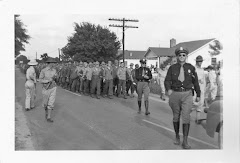
The photo at upper left was sent by Captain Klippen's son Chris who recently discovered the existence of the Aliceville Museum http://www.cityofaliceville.com (Click on POW Museum). The photo shows Captain Klippen with his older son Art (Arthur G. Klippen) and was taken in Aliceville in May 1944. The photo was given to Chris by his sister Nina.

Captain Klippen was born in 1909 in Duluth, MN to immigrant parents from Norway. He earned a Master's degree in chemistry and taught at a junior college before deciding to study medicine. He received his degree from the medical school at St. Louis University in 1938 and, like many medical students at the time, accepted a commission in the Armed Forces.

Captain Klippen's first duty was to sit on a medical draft board. He traveled throughout the south and met his wife, Zora Grijack, at Fort Benning, GA in 1940. Zora was a lieutenant in the Army Nursing Corps and scheduled to go to the Phillipines when she resigned her commission to marry Klippen. Many of her nursing friends who did go on to be stationed in the Philippines were there when the island fell to the Japanese and were held in brutal POW camps until the American liberation later in the war.

Following Captain Klippen's service as Medical Officer at Camp Aliceville, he received orders to the Pacific in anticipation of the invasion of Japan. He was on a ship headed to the Pacific Theater when the atom bombs were dropped and the war ended.

After the war, Klippen was in private practice as a family physician in Michigan. In 1955, he began work for the VA medical centers, working in the Central Office in Washington, D.C. and then serving as Hospital Director for the Ann Arbor (Michigan) VA. In 1969, he transferred to the Minnesota VA and retired there as Hospital Director in 1977. He and Zora lived in Maple Lake, MN until his death in October 1997. Zora died in 2001.

The child in the photograph above, Arthur G. klippen, served in the US Army as a second lieutenant in Vietnam. He was killed in action on August 25, 1966 and was posthumously awarded the Silver Star for "gallantry in combat." It is fitting that he and his parents, who served their country well, are buried together in the same plot in Arlington National Cemetery.

Chris Klippen is donating an oil painting to the Aliceville Museum. It was created by one of the German POWs and given to his father. The painting, done on the back of a piece of military posterboard, shows the recreation area and barracks of Camp Aliceville.


A SIDE NOTE: Chris Klippen, Mary Bess Paluzzi (Director of the Aliceville Museum), and I share a common bond. All three of our fathers were scheduled to be involved in the invasion of Japan at the time the atomic bombs were dropped on Hiroshima and Nagasaki. Mary Bess's father had been badly wounded in Europe in November 1944 and was just being released again for active duty when he expected to be reassigned to the Pacific. Chris's father was on a ship headed to the South Pacific for the invasion of Japan, and my father (see Introduction to Guests Behind the Barbed Wire) was already stationed at Okinawa and training for that invasion.

Monday, November 30, 2009

Aliceville Museum Director Adds to Information About Mayhall Photos

Aliceville Museum Director Mary Bess Paluzzi was fascinated with the photos of WWII Aliceville posted to this blog by Bruce Mayhall. She noted that Billie Frances Pate worked at the soda fountain in Jones Drugstore at that time. "I always heard that she was a very beautiful young woman," Mary Bess wrote in an e-mail, "and this photo proves it."


If any of my readers visit the Aliceville Museum, they will see a beautiful display case that contains the Marine Corps uniform of Sergeant Major Albert Thomas Kirk, who became Billie's husband. In additiion to the large collection of memorabilia from Camp Aliceville, the museum also houses numerous displays of American military memorabilia from World War II.

Saturday, November 28, 2009

Pete Mayhall's Aliceville Experiences IV


Above are the final three Aliceville photographs from Bruce Mayhall. They definitely capture the mood and setting of the time. Above left are a couple named Dot and Hugh in front of Jones Drugs. Above right are Billy Mouchette and Olga Gibson out for a bike ride, and bottom right is Mr. McDaniel, the owner of the bowling alley where many MPEG guards took their dates for fun on weekends.
When WWII ended in Europe, Pete Mayhall was able to combine his quartermaster experience and his experience with POWs to qualify for a position involved in disassembling the huge Allied quartermaster service in Cherbourg. In this effort, he used German POWs captured in France as his work force. This process took until approximately September 1945. He returned to the US on January 5, 1946.
After the war, Pete and Ruth Mayhall lived with his parents in Phil Campbell, Alabama for about three months before moving to Florence, Alabama. When their son Bruce wrote about their experiences in May 2008, they had been happily married for 64 years.
My thanks again to Bruce Mayhall for sharing his father's story and these special photographs.


Friday, November 27, 2009

Pete Mayhall's Aliceville Experiences III.

Jones Drugstore was a familiar gathering place in Aliceville during WWII. The first photo in this blog entry shows Billie Frances Pate standing in front of the drugstore which had a soda fountain.


This second photo shows Pete Mayhall's sister Bernice and her husband Hiram in front of the MPEG barracks at Camp Aliceville in 1944.
The stockade office inside the prison compound at Camp Aliceville was the storage location for money and personal items taken from German POWs when they arrived at the camp. These possessions were carefully recorded so they could be returned to the POWs at the end of the war.
Pete Mayhall has said that he didn't find it necessary to speak or understand German while at Camp Aliceville because many of the POWs spoke English. Before the war, they had been teachers or actors or had held other jobs requiring education.
Pete and Ruth Mayhall were with his sister Bernice and her husband at their home near the compound on the night of an attempted prisoner escape. They heard the sirens and the shots, and Pete recalls that the camp authorities had gotten intelligence that a break would be tried. His memory is that three or four prisoners were involved, and that guards in the towers fired on all of them.

Friday, November 20, 2009

Pete Mayhall's Camp Aliceville Experiences II.


Pete Mayhall married Ruth Clement on February 15, 1944 at the Sandusky, Alabama home of one of her former high school teachers. She joined him in Aliceville, and he then moved with her from his quarters in the camp compound to upstairs rooms in a house owned by the man who ran the bowling alley in Aliceville.


Ruth Clement Mayhall is seen at left. Her ID pass for Camp Aliceville is dated 6 March 1944. They shared a downstairs bathroom with another couple who rented rooms downstairs in the McDaniel house.

During the next three months, Pete and Ruth enjoyed picnics and travels through the Alabama countryside with other young military couples, including Pete's sister Bernice and her husband Hiram who was also stationed at Camp Aliceville.

Then came the secret plans for D-Day. Pete was on a ship crossing the Atlantic on June 6, 1944 when the invasion occurred http://www.history.army.mil/brochures/normandy/nor-pam.htm. His ship was constantly zigzagging to avoid German U-boats and their torpedoes. Once in Europe, he was part of the second wave of American troops to land, and he remained in Europe until the fall of 1945. His brother-in-law Hiram was shipped to Europe shortly after Pete. Both men survived the war, and Hiram remained in the Army after the end of the war.

Friday, November 13, 2009

Pete Mayhall's Camp Aliceville Experiences I.


Bruce Mayhall recently shared some of his father's experiences at Camp Aliceville during World War II, and I am happy to post these for my readers. Bruce wrote about these experiences in May 2008.


After enlisting in the Army in May 1942, Glen Howard "Pete" Mayhall was assigned to the Induction Center at Fort McClellan in Anniston, Alabama, where he interviewed draftees until April 1943 http://www.mcclellan.army.mil/Info.asp. Then his brother-in-law Hiram Duncan, who was an Army private, told Pete about a new company being formed for Camp Aliceville. Both men were promoted and sent to Aliceville, arriving before the first group of prisoners did in June 1943.


Pete was assigned to work in the company office, but after the German POWs began to arrive, he was moved into the compound and worked for the officer in charge, Captain Scott C. Strohecker. They worked with a First Lieutenant (possibly Nat Aicklen) as well as one or two secretaries who were civilian employees of the camp.


Pete's brother-in-law Hiram worked in the American section of the camp, and he and Bernice (Pete's sister) rented a house across the road from the camp.


The compound office, where Pete worked, was located in a building that sat between the housing for American soldiers and the compounds occupied by the German POWs. In the early years of Camp Aliceville, the prisoners organized much of their own lives inside the compounds, and the three Americans in the stockade office (Strohecker, the first lieutenant, and Mayhall) were among the few Americans who had access to the compound. Pete remembers that, when hard-core Nazis caused trouble with other prisoners, they were shipped out to other camps.


Pete remembers that the 1929 Geneva convention requirements about equal food and housing for prisoners were followed carefully, and that this caused considerable resentment among local citizens. On one occasion, a POW spokesman came to Pete and complained about the amount of bread the prisoners were receiving. Pete told him they were getting the same amount as the American guards, but Captain Strohecker, who was of German descent, understood the cultural differences and allowed more bread.


Prisoners often came to the stockade office with requests for materials they could use for creative projects to ward off boredom. Once, a prisoner named W. Reissig, who was an artist, asked for help in locating things he could paint. Later, Reissig gave Pete a painting he had created on mattress ticking with improvised colors found in the infirmary. The scene, Life on the Mississippi, reproduces a postcard Reissig obtained. This painting still hangs on the wall of the bedroom Bruce Mayhall sleeps in when he visits his parents' home in Florence, Alabama.


More of Pete Mayhall's recollections and photos of Alicevile during WWII will appear in subsequent blog entries.

Monday, October 12, 2009

Father of Heidelberg Waitress Spent Most of War at Camp Aliceville


I had an interesting e-mail recently from a man named John Coon, who is retired from the US Air Force. He spent the years 2000 to 2008 working for the US military near Heidelberg, Germany.


Shortly before returning to the United States, Mr. Coon was having dinner in a restaurant near Heidelberg when the English-speaking German waitress commented on his Southern drawl. During their subsequent conversation, she told him that her father had spent most of WWII at Camp Aliceville, and she knew many things about the former POW camp.

Mr. Coon plans to return to Germany and will try to find out more about her memories. If he does, I will post the information here.

He also reported the sad news that John Michael Parrish, son of Wendell Parrish, passed away near the end of September at the age of 61. Those of you who have read Guests Behind the Barbed Wire will remember that Wendell Parrish was the American airman who was interned at Stalag Luft IV and provided the contrasts for me between American POW experiences in Germany and those of German POWs at Camp Aliceville. We offer our sincere condolences to Wendell and his family.
PLEASE NOTE: The photos in this blog entry were provided by John D. Coon and are used with his permission.